Morgan +4 Forum
Vacuum leak/Carb Issue
Posted by Crowbar





|
SJM1
Jan Morgan
|
Aug 22, 2025 02:30 PM
Top Contributor
 Joined 8 years ago
2,310 Posts
|

What you want is a BSP/UNF adapter/reducer, but it is too late for that... Not everything is NPT (and there is occasional confusion between BSP and NPT, as the thread pitch is similar, but definitely not the same. You need the right BSP fitting to be sure). Or you could have retapped to NPT. There are many combinations of BSP to UNF bushings, often available from aircraft supplies such as Aircraft Spruce and Specialty, or metric specialists. In my experience, metric produced items are threaded BSP and not NPT (a common problem with Renault R5Turbo BEHR intercoolers that have had their BSP threaded sensor bungs mistaken for NPT, and stripped out). Both my UNF and Metric tap and die sets feature BSP taps and dies, where my SAE Fracti0onal sets have NPT. I heard about this problem once before, when the shop could not find out which threads the sending unit had, and gave up when the BSP threaded unit didn't fit into any NPT bushing that they could find. The shop didn't know about BSP...
And... You can re tap a bushing to take any other adapter you want. OR you can switch the sending units around to get the proper fit.
You can use helicoil to repair your radiator (Helicoils are used on everything from cylinder heads to water pumps, so leakage is not a problem), then seal the threads with Yamabond or Hondabond sealer. Works quite well and lasts for decades. And, when you want to take it apart, it comes apart, as it is a soft sealant. I use it to replace gaskets on thermostat housings when I don't have a fresh gasket, and use it to seal gaskets or replace thin paper gaskets in many applications. Never a leak.
The problem is that the new rad may have the same problem as the E Bay unit.
And... You can re tap a bushing to take any other adapter you want. OR you can switch the sending units around to get the proper fit.
You can use helicoil to repair your radiator (Helicoils are used on everything from cylinder heads to water pumps, so leakage is not a problem), then seal the threads with Yamabond or Hondabond sealer. Works quite well and lasts for decades. And, when you want to take it apart, it comes apart, as it is a soft sealant. I use it to replace gaskets on thermostat housings when I don't have a fresh gasket, and use it to seal gaskets or replace thin paper gaskets in many applications. Never a leak.
The problem is that the new rad may have the same problem as the E Bay unit.
|
SJM1
Jan Morgan
|
Aug 22, 2025 05:43 PM
Top Contributor
Joined 8 years ago
2,310 Posts
|
|
Crowbar
Greg Chronowski
|
Topic Creator (OP)
Aug 25, 2025 10:38 AM
Joined 10 years ago
49 Posts
|
about 1 month and 5 days later...
|
Crowbar
Greg Chronowski
|
Topic Creator (OP)
Sep 29, 2025 12:07 PM
Joined 10 years ago
49 Posts
|
So, I wanted to put a final, and happily, successful coda to the saga of my getting my 1965 +4 to run reasonably cool in the 100 degree Houston summers.
1) Though I bailed on the $120 Chinese EBay radiator, I probably could have gotten it to work if I had installed a 5/8"-18 helicoil in the temp sensor bung...this will always remain a "what if" scenario...and certainly would have saved A TON of money.
2) I finally have the $800 aluminum radiator from Morgan Spares installed. It's a high-quality item that is thicker than the EBay radiator, with smaller tanks on the top and bottom to accommodate a larger cooling surface area in a footprint that is the same as stock. . It fit perfectly...I painted it black using Eastwood Radiator Paint.
3) I installed the upgraded 6 blade water pump as well as the plastic 6-blade Morgan Spares fan...all work well. The fan is fairly loud, but moves A TON of air, so I'm happy. I know that some owners have shortened the fan blades to quiet the fan down a bit, but I need all the air movement I can get, so I'm not messing with it...
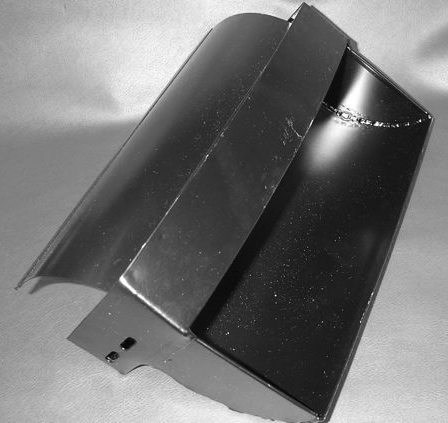
4) I purchased this cool lower air scoop from Morgan Spares as well. It replaces the stock cowl box, though I did have to lengthen the bolt holes to get it to fit my car. Many thanks to Laurence Plott for sharing his similar fabricated solution on which this product was clearly based.
5) On the advice of Larry at Morgan Spares...I DID NOT re-install my electronic pusher fan in front of the radiator. He said I won't need it with the bigger radiator and six blade puller fan - and that it would just block air flow. He was correct!
6) I bought a sheet of ABS plastic off of Amazon and built a shroud behind the grill to funnel all air into the radiator. I believe that this, and the lower air scoop made a significant difference.
7) I bought a timing light and set the timing to 30 degrees BTDC at 3,000 rpm. Car runs so much more smoothly now...and hopefully cooler as well.
The bottom line is that I took the car out in 95 degree Houston humidity a few weeks ago and when underway and moving, the needle never budged past the midpoint on the temp gauge. Before the above fixes it was always pegged at the very top. I checked the block temp with an IR thermometer after a 45min drive and the block read ~170-180 degrees. Before the fixes, 210-220 degrees were common after a long drive. Temp does creep up to the top of the gauge if I'm stuck at a traffic light for long, but drops to midpoint once I start moving again. This is one area where I believe the electric pusher fan could still make a difference...I may rig up a temporary fan mount and do some testing to see if the tradeoff between blocked air flow, and temp creep when stopped are worth it.
Many thanks to everyone here for their help - couldn't have gotten to this point without you all!
Edited 1 time(s). Last edit at 2025-10-01 10:05 AM by Crowbar.
1) Though I bailed on the $120 Chinese EBay radiator, I probably could have gotten it to work if I had installed a 5/8"-18 helicoil in the temp sensor bung...this will always remain a "what if" scenario...and certainly would have saved A TON of money.
2) I finally have the $800 aluminum radiator from Morgan Spares installed. It's a high-quality item that is thicker than the EBay radiator, with smaller tanks on the top and bottom to accommodate a larger cooling surface area in a footprint that is the same as stock. . It fit perfectly...I painted it black using Eastwood Radiator Paint.
3) I installed the upgraded 6 blade water pump as well as the plastic 6-blade Morgan Spares fan...all work well. The fan is fairly loud, but moves A TON of air, so I'm happy. I know that some owners have shortened the fan blades to quiet the fan down a bit, but I need all the air movement I can get, so I'm not messing with it...
4) I purchased this cool lower air scoop from Morgan Spares as well. It replaces the stock cowl box, though I did have to lengthen the bolt holes to get it to fit my car. Many thanks to Laurence Plott for sharing his similar fabricated solution on which this product was clearly based.
5) On the advice of Larry at Morgan Spares...I DID NOT re-install my electronic pusher fan in front of the radiator. He said I won't need it with the bigger radiator and six blade puller fan - and that it would just block air flow. He was correct!
6) I bought a sheet of ABS plastic off of Amazon and built a shroud behind the grill to funnel all air into the radiator. I believe that this, and the lower air scoop made a significant difference.
7) I bought a timing light and set the timing to 30 degrees BTDC at 3,000 rpm. Car runs so much more smoothly now...and hopefully cooler as well.
The bottom line is that I took the car out in 95 degree Houston humidity a few weeks ago and when underway and moving, the needle never budged past the midpoint on the temp gauge. Before the above fixes it was always pegged at the very top. I checked the block temp with an IR thermometer after a 45min drive and the block read ~170-180 degrees. Before the fixes, 210-220 degrees were common after a long drive. Temp does creep up to the top of the gauge if I'm stuck at a traffic light for long, but drops to midpoint once I start moving again. This is one area where I believe the electric pusher fan could still make a difference...I may rig up a temporary fan mount and do some testing to see if the tradeoff between blocked air flow, and temp creep when stopped are worth it.
Many thanks to everyone here for their help - couldn't have gotten to this point without you all!
Edited 1 time(s). Last edit at 2025-10-01 10:05 AM by Crowbar.

1854sailor
Paul Powichroski
|
Sep 29, 2025 12:44 PM
Joined 4 years ago
393 Posts
|
|
SJM1
Jan Morgan
|
Sep 29, 2025 03:21 PM
Top Contributor
Joined 8 years ago
2,310 Posts
|
I think that you have the right solution. A front mounted pusher fan is of limited advantage, as it covers about 30% of the cooling fin surface that normally would be directly exposed to the air. Unless the radiator is really large... a puller fan works better, but in your case with the larger, more efficient radiator and engine fan, you have the best solution. Even in traffic. I doubt that the engine temp will exceed 210F. Probably mostly around 200F, which is safe.
One thing to check is the accuracy of your temp gauge. I had one that was always reading a high temp (an accessory gauge installed because the previous owner didn't trust the cluster gauge. As it turned out, the accessory gauge was reading more than 20ºF high after several improvements to the cooling system, and in fact, the engine was running at a normal temperature. I found that the original cluster gauge was in fact, pretty accurate, with the mid point at about 180 or so. This matches the 175 thermostat opening temp.
Read the temps off of the top tank of the radiator or the thermostat housing. This will give you the most accurate water temp reading.
One thing that I would avoid, though it is very popular, is the use of Water Wetter. I recently replaced a radiator that had long term usage of Water Wetter (a couple of decades, with regular coolant changes) and found that the rad was occluded with a white crystalline substance. Funny, but I was warned of this at a seminar at Saleen's race shop in the mid 90s. They offered that Water Wetter would leave a substance in the radiator, and eventually would reduce the radiator's cooling ability. And so, after a couple of decades, there was my proof... I now just use 50/50 antifreeze (G-O5, for alloy engines). In 20 years, I will be close to a century old, and my daughter can rest assured that there will be no Water Wetter residue clogging the Morgan's radiator.
An oil cooler can also help. The extra quart of oil can take about 15F out of the engine oil temp, with the heat exchanger taking out another 50F. All this will help control the coolant temps, even in traffic.
One thing to check is the accuracy of your temp gauge. I had one that was always reading a high temp (an accessory gauge installed because the previous owner didn't trust the cluster gauge. As it turned out, the accessory gauge was reading more than 20ºF high after several improvements to the cooling system, and in fact, the engine was running at a normal temperature. I found that the original cluster gauge was in fact, pretty accurate, with the mid point at about 180 or so. This matches the 175 thermostat opening temp.
Read the temps off of the top tank of the radiator or the thermostat housing. This will give you the most accurate water temp reading.
One thing that I would avoid, though it is very popular, is the use of Water Wetter. I recently replaced a radiator that had long term usage of Water Wetter (a couple of decades, with regular coolant changes) and found that the rad was occluded with a white crystalline substance. Funny, but I was warned of this at a seminar at Saleen's race shop in the mid 90s. They offered that Water Wetter would leave a substance in the radiator, and eventually would reduce the radiator's cooling ability. And so, after a couple of decades, there was my proof... I now just use 50/50 antifreeze (G-O5, for alloy engines). In 20 years, I will be close to a century old, and my daughter can rest assured that there will be no Water Wetter residue clogging the Morgan's radiator.
An oil cooler can also help. The extra quart of oil can take about 15F out of the engine oil temp, with the heat exchanger taking out another 50F. All this will help control the coolant temps, even in traffic.
|
Crowbar
Greg Chronowski
|
Topic Creator (OP)
Oct 1, 2025 10:06 AM
Joined 10 years ago
49 Posts
|
|
Crowbar
Greg Chronowski
|
Topic Creator (OP)
Oct 1, 2025 10:12 AM
Joined 10 years ago
49 Posts
|
In reply to # 28965 by SJM1
I think that you have the right solution. A front mounted pusher fan is of limited advantage, as it covers about 30% of the cooling fin surface that normally would be directly exposed to the air. Unless the radiator is really large... a puller fan works better, but in your case with the larger, more efficient radiator and engine fan, you have the best solution. Even in traffic. I doubt that the engine temp will exceed 210F. Probably mostly around 200F, which is safe.
One thing to check is the accuracy of your temp gauge. I had one that was always reading a high temp (an accessory gauge installed because the previous owner didn't trust the cluster gauge. As it turned out, the accessory gauge was reading more than 20ºF high after several improvements to the cooling system, and in fact, the engine was running at a normal temperature. I found that the original cluster gauge was in fact, pretty accurate, with the mid point at about 180 or so. This matches the 175 thermostat opening temp.
Read the temps off of the top tank of the radiator or the thermostat housing. This will give you the most accurate water temp reading.
One thing that I would avoid, though it is very popular, is the use of Water Wetter. I recently replaced a radiator that had long term usage of Water Wetter (a couple of decades, with regular coolant changes) and found that the rad was occluded with a white crystalline substance. Funny, but I was warned of this at a seminar at Saleen's race shop in the mid 90s. They offered that Water Wetter would leave a substance in the radiator, and eventually would reduce the radiator's cooling ability. And so, after a couple of decades, there was my proof... I now just use 50/50 antifreeze (G-O5, for alloy engines). In 20 years, I will be close to a century old, and my daughter can rest assured that there will be no Water Wetter residue clogging the Morgan's radiator.
An oil cooler can also help. The extra quart of oil can take about 15F out of the engine oil temp, with the heat exchanger taking out another 50F. All this will help control the coolant temps, even in traffic.
One thing to check is the accuracy of your temp gauge. I had one that was always reading a high temp (an accessory gauge installed because the previous owner didn't trust the cluster gauge. As it turned out, the accessory gauge was reading more than 20ºF high after several improvements to the cooling system, and in fact, the engine was running at a normal temperature. I found that the original cluster gauge was in fact, pretty accurate, with the mid point at about 180 or so. This matches the 175 thermostat opening temp.
Read the temps off of the top tank of the radiator or the thermostat housing. This will give you the most accurate water temp reading.
One thing that I would avoid, though it is very popular, is the use of Water Wetter. I recently replaced a radiator that had long term usage of Water Wetter (a couple of decades, with regular coolant changes) and found that the rad was occluded with a white crystalline substance. Funny, but I was warned of this at a seminar at Saleen's race shop in the mid 90s. They offered that Water Wetter would leave a substance in the radiator, and eventually would reduce the radiator's cooling ability. And so, after a couple of decades, there was my proof... I now just use 50/50 antifreeze (G-O5, for alloy engines). In 20 years, I will be close to a century old, and my daughter can rest assured that there will be no Water Wetter residue clogging the Morgan's radiator.
An oil cooler can also help. The extra quart of oil can take about 15F out of the engine oil temp, with the heat exchanger taking out another 50F. All this will help control the coolant temps, even in traffic.
Interesting point about Watter Wetter...hadn't heard that... I have used it in all my cars in the past. I drain the coolant once a year...I won't add any next time.
An oil cooler is next on the list!
Having trouble posting or changing forum settings?
Read the Forum Help (FAQ) or click Contact Support at the bottom of the page.